

Video has become one of the most powerful ways for businesses to communicate. Companies use video to introduce their brands, explain their services, demonstrate products, educate customers, recruit employees, build credibility and ultimately generate business.
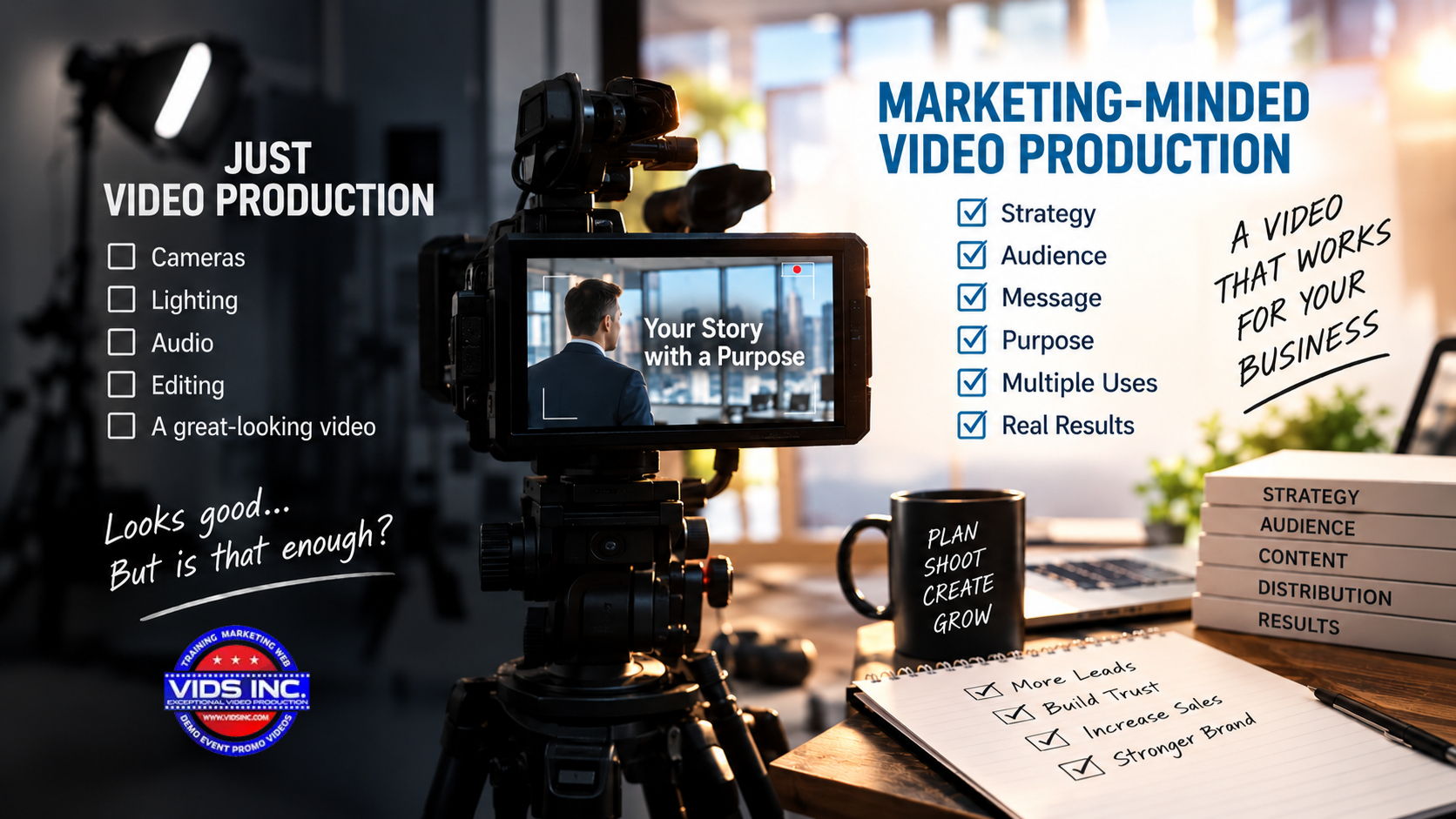
But there is an important difference between creating a professional video and creating a professional video with a marketing purpose.
A beautifully produced video can have incredible camera work, perfect lighting, impressive graphics and great music—and still fail to accomplish anything meaningful for the business.
That’s why choosing the company behind the camera matters.
When your video production company also understands marketing, the conversation doesn’t begin with, “What kind of video do you want?”
It begins with a much more important question:
“What do you want this video to accomplish?”
The Strategy Comes Before the Camera
A traditional video production company may begin by discussing cameras, locations, scripts, interviews, lighting and production schedules. Those things are certainly important.
A marketing-minded production company starts earlier.
Before deciding what should be filmed, we need to understand who needs to see it, what they need to hear and what we want them to do next.
Is the goal to generate leads?
Build trust?
Explain a complicated service?
Introduce a new product?
Help your sales team close more business?
Improve your website?
Answer questions potential customers are already asking?
Establish your company as an authority?
Those answers should influence everything that happens during production.
At Vids Inc, we believe the camera is a tool. The strategy determines how that tool should be used.
A Great-Looking Video Isn’t Necessarily a Great Marketing Video
Production quality matters. Your company should look professional.
But looking professional is only part of the job.
Imagine spending thousands of dollars creating a beautiful corporate video. Everyone loves it when they see it for the first time. Your employees share it. Your leadership team compliments it.
Then six months later, someone asks:
“What did the video actually do for us?”
That’s when the difference between video production and strategic video production becomes important.
Before creating the video, there should be a clear understanding of what success looks like.
A marketing video shouldn’t simply look good.
It should have a job.
Understanding the Customer Changes the Video
One of the biggest advantages of having marketing experience behind your video production is understanding that the video isn’t really about your company.
It’s about your customer.
Businesses naturally want to talk about themselves.
“We’ve been in business for 25 years.”
“We have great customer service.”
“We use the latest technology.”
“We have experienced employees.”
Those things may be important, but your potential customer is usually thinking about something completely different:
“Can you solve my problem?”
Marketing helps translate what a company wants to say into what its customers actually need to hear.
That difference can completely change the script, interviews, visuals and ultimately the effectiveness of the video.
Our SWOT Process Helps Determine the Message
At Vids Inc, part of our pre-production process can include looking at four important areas:
Strengths. Weaknesses. Opportunities. Targets.
What does your company do exceptionally well?
Where are competitors outperforming you?
What opportunities exist in your market?
And most importantly, who are we trying to reach?
Once we understand those things, we can develop a clearer and more consistent message.
Now the script isn’t simply a collection of information about your company.
It has a purpose.
The interviews have a purpose.
The B-roll has a purpose.
The call to action has a purpose.
Even decisions about what not to include become easier because everything can be measured against the objective of the video.
One Shoot Can Create Multiple Marketing Assets
Another advantage of thinking about marketing before production is that you can plan for how the footage will be used after the main video is finished.
Instead of thinking:
“We’re making a three-minute company video.”
We can think:
“We’re creating video content that can work throughout the company’s marketing.”
During the same production, there may be opportunities to capture footage for the company’s website, YouTube channel, social media, sales presentations, recruiting, customer education, short-form videos and future campaigns.
That can dramatically increase the value of a production day.
The difference is planning for those opportunities before the cameras arrive.
You can’t always go back and capture the perfect shot, interview answer or sound bite after production is finished.
Strategic pre-production helps make sure you’re capturing the right content while everyone, everything and every piece of equipment is already in place.
Video Can Support Search and Discovery
Businesses also need to think about how people will discover their videos.
YouTube is a search platform. Google displays video results. Potential customers search questions related to products and services every day.
That means the subject of your video matters.
The title matters.
The questions you answer matter.
The language your customers use matters.
Instead of producing videos solely around what a company wants to talk about, marketing strategy can help identify subjects that potential customers are already interested in.
That creates an opportunity for video to do more than explain your business.
It can help people discover your business.
Your Sales Team Can Use Video Too
Some of the most valuable videos may never become advertisements.
Imagine a salesperson having the perfect video to send after speaking with a prospect.
A customer asks a common question.
Instead of writing a long email, your salesperson sends a 90-second video explaining the answer.
A prospect wants to understand your process.
There’s a video for that.
They want to see the facility.
There’s a video for that.
They want to hear from one of your customers.
There’s a testimonial for that.
When video production is approached strategically, you’re not simply creating content.
You’re building a library of sales and marketing tools.
Production Still Has to Be Excellent
None of this means production quality becomes less important.
It’s actually the opposite.
Once the strategy and message are right, professional production helps deliver that message in a way that represents the quality of your company.
Lighting matters.
Audio matters.
Composition matters.
Directing matters.
Editing matters.
Graphics matter.
Music matters.
Storytelling matters.
But those production elements should support the objective—not become the objective.
Strategy tells us what story needs to be told. Production determines how effectively we tell it.
When you have both working together, video becomes much more powerful.
Before You Hire a Video Production Company, Ask One Question
When you’re comparing companies to produce your next video, don’t only look at cameras, equipment, demo reels and production quality.
Ask them:
“How will you determine what this video should actually say?”
Their answer will tell you a lot.
Because your business doesn’t need another video sitting on a website or YouTube channel collecting views without accomplishing anything.
You need video with a purpose.
At Vids Inc, we combine professional video production with marketing strategy so that before we decide what we’re going to shoot, we understand why we’re shooting it, who needs to see it and what we want them to do after they watch it.
Because the goal isn’t simply to create a great video.
The goal is to create a great video that works for your business.
Ready to Put Video to Work for Your Business?
If you’re considering a corporate video, promotional video, testimonial, training video, product video or ongoing video content, talk with Vids Inc before you turn on the camera.
We’ll start with your business objectives, your audience and your message—and then determine how video can help you accomplish them.
Vids Inc — Video Production With a Marketing Purpose.